Friday, May 24, 2013

Coulee Climbs and Straightaways: Backroad Route 174, 17, and 2


It's been way too long since a backroads post. Now, as then, my route is anything but a back road to the locals, and I apologize for any offense they might take (and remind them that I am avoiding telling the general public about the really good backroads). It covers a fair stretch of Route 2, only a backroad compared to I-90, but to get right down to it, 90 probably does have 100 cars to every 1 on 2.

But let me back up a sec. Route 2 was the third leg of this trip. The joints of these legs: curving grades making their -scents (de- or a-) as the westward course confronted coulees and a river. Between the joints, longbones straight and narrow; straighter than the crow flies, lies the engineer's centerline. The surveyor runs due south, mile after mile, and Route 17 is born; turning 90 degrees west, he draws Route 2 to Waterville. Up north, Route 174 does bend a bit more, flexing to the landscape and paths discovered by creatures and the people that hunted them ever since the end of the Ice Age. 


Taking off out of Grand Coulee on 174 begins with a climb, and you cross under one of the primary electric umbilicals of the Power Grid. The towers march off on their line, and174 takes off through some pretty country, especially late on a warm Spring day.

Coulee climb #1: Outta Grand Coulee (or is that Coulee City?)
The 174 - 17 junction is a fork no matter how you approach it, and there are yield signs, but the only vehicles I've encountered there are truckers pulled over for a rest. I usually do the same for a few minutes to rearrange the growing midden in my truck and stretch my legs with a walk through the empty intersection.


There's the mildest switchback ever ascending to the next plateau, and then straightest of  shots beyond. The road only makes sense if your concept of land is a grid. Until the last century, everyone traveled up and down the coulee (you know, where there's food and water), and you can still do it on RT 155, but once the land is cut into sections and quarters, and you need to get grain to market, a road straight through the fields makes sense. It's modern agriculture's umbilicus to markets for petrochemicals in and food out, laid down on the Cartesian Grid.

Tanks (for fuel? fertilizer?) and Elevators (for output) on Route 2.
After miles of wheat and linearity, 17 descends back into the coulee, not near the Grand Coulee the city, but the city of Coulee City, all of which may just be towns when it comes down to it. There are more power lines, although this is the lower end of Banks Lake, which is an irrigation reservoir than a hydroelectric project; they both depend on Grand Coulee the dam. Banks Lake and the canals flowing from it are the umbilical waters flowing onto the farms partitioned along the Township Grid.

Monotonously straight as much of this route may be, there are a few breaks that take my breath away. Like entering Moses Coulee.


Looking across the sage at golden cliff walls with cocoa talus skirts, I am in love with this place every time I see it. Luckily (and with some attention to timing), I have been through here many times in the fading afternoon, and every time, it is a blessing.

This last trip, on that big coulee-climb up from Moses, I shot out onto the top and into a straightaway pointing right into the setting sun. Beautiful, too, but also difficult driving. Glare in the face, windshield lit with dozens of bugsplats, each a tiny firework of captured sun in my eyes, scratch refractions, a haze of dust alight across it all, shiny tarlines on the road reflecting even more sun from the ground up.

Luckily, there was nearly no traffic, and what little there is is visible from miles away. Because I guess even Route 2, mightiest of the 174-->17-->2 run, is a backroad in the interstate age. Lonely straightaways where driving is as simple as it gets and you can take in the country, which is flat and clear enough that it passes at a stately pace, not much in the foreground to whip by in a blur. I'm pretty sure I was out of cell range for most of the trip, which also felt good, getting off the Communications Grid (even if I was confined to the road engineer's east-west north-south orientation).

Wednesday, April 24, 2013

Watching Bird Watching Art

"X never marks the spot." -Indiana Jones
This could be anywhere, but it is in Scottsville, VA. I just happened through, and it must have been Arts Walk or something, because here was this pigeon with an elaborate installaton.

Sure, what people noticed first was the massive scaffolding surrounding a large lone building, a brick of red in a crochet of scaffold rust. Especially nice against the Spring-greened dike and trees stretching out behind.

Then, perched in a pinnacle of empty panes, there stands the artist. In the crux of the X, smack-dab at scaffold-center stands an iridescent neck flanked by grey shoulders, rising from sleekness against darkness of the warehouse cavern. And atop this oiled rainbow of a neck, a head sharply grey, whetted by an eye piercingly orange, an orange borne of the saturatallucinated union of the brick and rust all around.


The artist glances one way then the other over and over, one eye always focused right on you. Nobody can explain how the pigeon simultaneously looks into each eye of everyone below, but it happens nonetheless. Meanwhile, the profile either reflects or parallels the pigeon's clever pecking of a pigeon-profile void in the pane to our left. Juxtaposition of the breast curve--a sublime, eloquent line depicting beauty all puffed-up and proud--with the shattered lines converging at the head (is that a woodpecker?) is nothing short of brilliant. 

Meanwhile, above and to the right, we see Pigeon's nod to the landscape. A mountain profile appears in the broken corner pane. Sophisticated as this installation surely is, a moment of simple representational art is not beneath it. A certain amount of self-mockery appears to be part of this Scottsville aviant garde piece as well: the artist's feet are a hilariously awful color. Just as the eye-orange clinches the artist's brilliance as a colorist, the scaly alcoholic-clown's-nose colored feet establish this pigeon as a humorist.

So, Bravo Scottsville Pigeon. You took a ruin and made it a font of creativity. You showed us that Pigeon-Americans are not just garbage-scrounging winged rats, and I think you showed those snooty NY birds a thing or two about real art.


\

Saturday, April 20, 2013

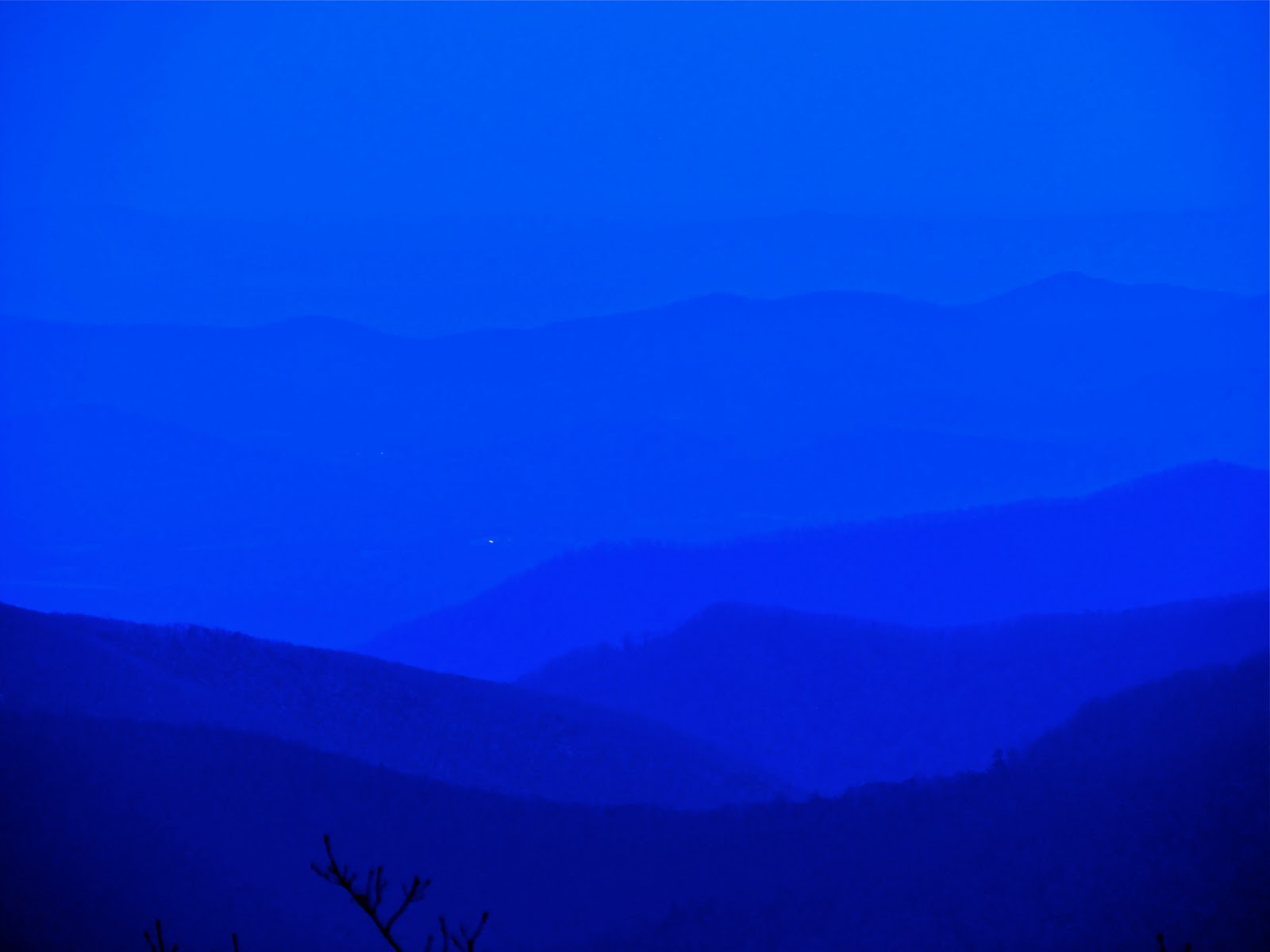
Blue Ridge: Distant


From Spy Rock, on a clear and slightly hazy day.


Same shot, blued up a bit.


Blue to da max.

Thursday, April 18, 2013

Blue Ridge: Close

Beyond time to plant corn, according to oak leaves larger than mouse ears.
The second week of April in the Blue Ridge mountains in this wild year of Winter-straight-to-Summer, buds responded to the 40's to 90's weather by exploding. I walked through woods in their last gasp of long visibility, canopy emerging.


And flowers, too. Roadside redbuds blossoming ahead of their understory kin. Other flowers I do not know on branches above the fading daffodils strewn in the woods.


Meanwhile, the less glamorous trees flicked a fleeting beauty, befire getting on with their biomassing.


 And their Virginia creeping.


Meanwhile, in civilized clearings of the foothills, imported Asian magnolias danced, tossing off petals into the heated air.


Flowers and leaves battled it out to adorn the water color sky.


The tulip poplar began it's year of display.


A grave-side hawthorn stood guard, stark against the sky in these days before flower and foliage soften its profile.


The orchard trees beckoned bees.


And ornamentals let it be.


Belle blossoms pealed.


Buckeye foliage unfurled.


And sumacs shouldered their way in.

Friday, April 12, 2013

Bird, Watching


I've been in the Eastern US for the past couple of weeks, spending some time in woods just waking up from Winter. Just about a year and 3,000 miles from the Watercolor Spring post, these woods have a similar open grey lattice, dappled lightly with the colors of emerging leaves, but here there are so few evergreens that you can see much farther. 

In the forests and orchards, birds abound now, and I could not help but watch them. Long ago, I worked for a local Audubon Society, running a small bookstore and learning about birds as I went. I never became a Birder, that species of naturalist obsessed with amassing the longest "life list" of species observed, often as not, through massive and expensive scopes. Yes, I've seen some cool birds in remote and exotic locales, but mostly because I was working there, not because I'd planned a trip to see the birds. If the bird is pretty, or doing something interesting, it doesn't really matter to me whether it is rare; what it eats or is eaten by--how it fits into it's ancient or adopted ecology--ends up being just as important as whether it qualifies as a rara avis.


So, this one was worth watching. It's a thrasher (a species that sticks in my memory because of it's punk-sounding name and it's virtuoso voice), neither rare nor far afield. I sat in an orchard on the Blue Ridge, appreciating the blossoms when it's rusty back came into view. Unlike most birds, who know to dart away or duck behind a branch as soon as the camera comes out, it just sat there while I took a shot, and another, moved around to get a better view, and even when I stepped closer. For about 15 minutes, this continued, and it was aware of me, but not inclined to take flight. It was watching me as much as I was watching it.


Later on, wandering through the woods, I came upon a family of crows, also wandering through the woods, pecking through last Fall's leaves. Through long experience with jealous farmers and rock-wielding boys, they made sure one was always watching me, and kept their distance. No unobstructed posing, no sitting still while I got closer. But also, no stopping what their foraging sweep through a Virginian forest floor. Like the guard pictured above, they were hitting the ground hard enough to poke through the leaves and into the red piedmont clay. Like the sentinel pictured above, they kept their beaks open, but said nothing; maybe they were cocked and ready to snap up bugs, maybe they were panting away the heat. 

My limited bird brain cannot say for sure what the thrasher or the crows were doing. All I know is that they watched me watch them.

Monday, March 11, 2013

In the Owls' Lee


According to today's Washington Post, Owlsley (I cannot help pronouncing it that way) just died. He was the guy who manufactured vast quantities of acid, kick-starting whatever it was that roiled up in late-1960s America. Although this was not one of their featured stories (in fact, I could not find it on the home page), it was among the Top 5 Most Popular stories. Nearly 50 years later, the psychedaelic flashtershocks can crest where you least expect them.

I was not part of that. LSD is too powerful for mind like mine. But for Owsley fans few photos of Mount Baker from the southwest tip of the peninsula that is the northwest tip of the Lower 48. You can rest assured that within the frame of each shot, there are hundreds of owls and probably quite a few Lees.


Or, how about realizing that as you gaze at the mountain, this is right behind you?


Friday, March 8, 2013

Pristine?

Oak savannah, pasturized.

Sometimes, my work brings me together with folks trying to do something called "restoration," by which they mean bringing the local ecology back to it's allegedly natural state, returning the pristine conditions pre-dating human intervention. Like the romantic ideal of Noble Savages, the concept of a totally natural, pre-human landscape is a concoction of minds less sophisticated than they conceive themselves to be.

Fortunately, the effects of Homo sapiens are clear enough in the NW environment that most ecologists recognize it, even if they are not quite ready to let modern humans interlope in preserves. Glaciers covered most of Washington until humans traipsed there, or pulled their umiaks ashore. As the ice retreated, human influence advanced across the land and sea, changing them. Many of you may have read that the Clovis people swarmed over the continent, killing and eating Pleistocene megafauna, perhaps extincting those camels, mammoths, and their ilk in the process. 

But meat ain't sustenance enough. There are vitamins and minerals, trace substances that don't show up in flesh, and people have always recognized that, or we would not be here now. So people pick shoots and dig roots. They gather weeds and harvest seeds to suit dietary needs. In a land where people showed up in glacial aftermath, it defies plausibility to believe that historic plant communities (and the animals that fed upon these) are the result of some pristine proces unsullied by the human touch. The touch that grabbed food and spread seed.

In the maritime Northwest, and in swaths of the interior, meadows and prairies have existed for thousands of years because humans spread fire to keep forests at bay. Savannahs had roots and oaks because people liked to eat carbs and acorns, because people had a hankering for the flesh of small and large four-leggeds with similar appetites.

So it strikes me as odd when "restoration" projects are based on the concept that the human influence should be eliminated. Often as not, the prescription is based on a floral community known from the late historic period or from a testbook, rather than the plants that actually occured on a particular piece of land. In the charcoal of an ancient campfire and in the pollen that fell between plank houses, the material remains of the actual environment is there to be seen, but I'm not sure if this record has ever been consulted.  

To admit that a landscape is not pristine is not to say that the place is defiled, just like not all people who've lost their virginity are craven whores. People in many places, the Northwest among them, learned how to nudge the ecology of a place toward a stasis in which large primates could eat well and the water, fungi, plants, two-leggeds  and four-leggeds could all get along. Sure, some natural successions were cut short, some species prospered at the cost of others, but this no less true in places where humans don't tread. The fact that archaeologists have found camas ovens buried thousands of years before foreigners strode in and found flourishing camas prairies suggests that a balance was achieved. 

Why then would newcomers presume to march in and insist on a "natural" landscape that locks out humans?